
First Published September, 2016, in VetScript. This is an extract from my original piece by the same name, which can be viewed here.
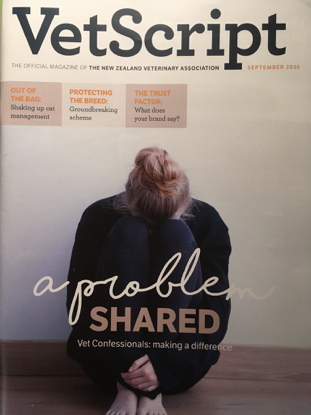
It’s a familiar scene. We sit in restless quiet in a too-hot room, pens shuffling against refill pads, laptop keyboards clicking, trying to keep our notes coherent, notes that all too soon will be our lifeline for exam study, but right now are vanishing into the sleepy haze of afternoon lectures. The lecturer keeps talking, flicking through slide after slide, assuming we are paying attention, because we are supposed to be young professionals, supposed to be better, somehow, than we are. I check my watch every minute, because every minute feels like 10. When the lecturer finally finishes, we stumble to our feet, inertia replaced by movement as we try to be first out the door.
Biking home, I cry into the rain, wishing someone would see me, stop me, notice that something’s wrong. But no one does. Once home, it’s a hot cup of tea, and I drag out the chocolate that’s hidden in the back of the pantry ‘for emergencies’, choking on a slightly hysterical laugh (or maybe sob) because there hasn’t been a single day this semester when the chocolate tin hasn’t come out.
Sometimes before I can work I pace the room, restless and trapped, looking for a way out when everything that’s holding me is inside my head. Sometimes I collapse on my bed and stare at the wall, seeing nothing, tears running into my hair. Sometimes I just sit hunched over the desk, head in hands, until that demanding little voice inside drives me to work. It always does, sooner or later.
A simple rule for good life balance is 8+8+8: eight hours study, eight hours sleep, and eight hours for nurturing yourself. Those last eight hours have a way of disappearing. We spend seven to eight hours in class every day, but still need time outside of class to study or work on assignments. Then there’s commuting, cooking meals, buying groceries and running errands, and suddenly the eight hours are used up. Often it feels that if we are to get through the degree we have to sacrifice everything else that matters.
Of course this is true for many students, but the sheer volume of material covered in the veterinary degree makes it especially difficult to keep on top of things and stay healthy. The truth is, the student counseling service saw approximately 28% of veterinary students last year, but only 9.5% of students from other degrees.
After close to 15 years at Massey, Dean of Veterinary Science Jenny Weston has her own theories on why vet students struggle with stress more than those in other disciplines – the ‘high achievers syndrome’, explaining that these students tend “to be high-achieving, driven individuals who set very high expectations on themselves”. Veterinary students, who have to be the brightest and best to make it into the degree, are often used to being top of their class. Suddenly they are in a class composed entirely of very bright students, and most are going to come in middle or bottom. Some students may never have failed a test, and don’t cope well doing so for the first time in vet school. This environment leads some students to question their academic abilities, or feel they are frauds.
In our first days as timid and slightly shell-shocked ‘baby vets’ we were encouraged to form what Mark Rainier head of Massey Student Counselling Service, describes as both the strength and the Achilles heel of vet school: the cohort. For the next four-and-a-half years, from selection through to graduation, a vet class stays together, and usually bonds strongly. We describe ourselves as family, share notes, celebrate and commiserate together. It’s a support system that is perhaps the only way of making the long haul of the degree bearable; however these bonds can hinder as well as help. I struggled for half a year with the mounting feeling that I needed to take a break from vet school, always conscious that taking time out would mean losing my class.
I explored the idea of taking a year off. Among the myriad fears and doubts competing for headroom, was anxiety that I might be letting down my loved ones, countered by the fear that things would keep getting progressively, unbearably worse. Every day was endlessly long. I tried to concentrate in class but found my mind constantly drifting. Most mornings I forced myself out of bed only to end up on the floor in tears because even putting my socks on seemed too hard. I was just incredibly tired, in a way I’d never been before. I wanted to sleep, for weeks if necessary, until I could wake up and be myself again.
In the end I took the year off, my way of stopping the world from spinning on endlessly. It was the hardest decision of my life, but in the end it seemed the only one I could make.
The defining characteristic of my bad times was feeling alone. When I announced my decision to take a year off, my classmates were understanding and supportive, and some admitted that they were struggling too. High-achievers find it extremely hard to admit they’re not coping, and perhaps my contribution was to make that slightly more ‘normal’. Six months on, I am sure that taking this year out from vet school was the right decision – but whether I will go back or not is yet to be decided. The idea of returning is daunting, but I am stronger now, better prepared, and ready to admit just how hard it is and not fall into that high-achievers trap. I am still not sure what the future holds, but at least I am beginning to feel like myself again.
Notes on sources:
The “8+8+8 rule” is a healthy lifestyle concept mentioned in a confidential interview with a Massey vet student.
Statistics on numbers of students (Vet students and Other students) seen by the student counseling service for 2015 were provided by head of service Mark Rainier, in a Skype interview on 18/5/16. Calculations are based on the assumption that each class for 2015 contained 100 students, as is the norm. Information on student numbers at the Massey Manawatu campus that were used for these calculations was sourced from: http://www.massey.ac.nz/massey/student-life/about-our-campuses/manawatu-campus/manawatu-campus_home.cfm
Quotes and information in the paragraph beginning “I met with Jenny Weston…” are from an interview with dean of veterinary science Jenny Weston, on 13/5/16.
Information on cognitive and personality factors related to suicide risk, including ‘high achievers syndrome’ as discussed in the paragraph beginning “I met with Jenny Weston…” was sourced from: Bartram, D. J., and Baldwin, D. S. (2010). Veterinary surgeons and suicide: A structured review of possible influences on increased risk. Veterinary Record. doi: 10.1136/vr.b4794
The paragraph “Consider also the warning…” refers to an automated warning seen on the Massey Stream site (Moodle) on enrolling for third year vet papers at the end of 2014.
Description of the vet student cohort as both strength and Achilles heel is based on a quote from Skype interview with Mark Rainier on 18/5/16.
 Erin Marieke Maessen
Leave a comment